EN / FR
Skip to main content

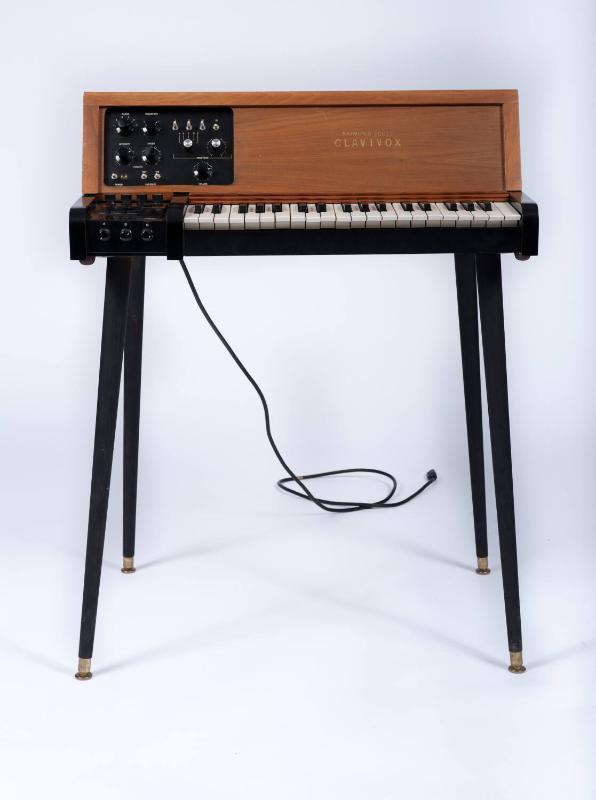
Raymond Scott Clavivox

Not available for use in Recording Studios
Not currently on exhibit
Artifact TypeSynthesizer
Manufacturer LocationUSA, North America
Date1957
The Clavivox is, effectively, a keyboard-controlled Theremin. It uses the same electronic sound-generating mechanism, but replaces the instrument’s antennae with a chromatic keyboard. For musicians already trained on a piano, this provided a much more intuitive approach. Designed in the early 1950s by inventor and composer Raymond Scott—better known for his compositions for Warner Bros. cartoons such as Bugs Bunny and Porky Pig—it’s an incredibly rare artifact. So rare, in fact, that NMC’s Clavivox is believed to be the only one in existence.
Operation/Functionhis artifact features a three-octave (plus one note; C through to C) keyboard. The keyboard is monophonic (meaning that only a single key may be played at any one time) and incorporates an early instantiation of portamento, or glide, allowing the user to slide gradually rather than jump abruptly between two pitches. The pitches need not be adjacent; the larger the gap between the two notes, the more perceptible the effect, in some cases resembling a glissando. Although pitches may be selected only from within the three octaves of the given keyboard, the allowable keyboard range may be adjusted to span any three-octave portion within a full eight octaves. This means that the lowest C on the keyboard may be shifted down by a single octave, or up by at most four octaves. The instrument offers four basic waveforms: sine, sawtooth, triangle, and square. The nature of these waveforms may be modified in several ways via the control panel located on the left of the instrument’s front, which contains controls for varying the instrument’s dynamics (volume), vibrato, tuning, and articulation (envelope). Vibrato and envelope control are accessed via four levers, or sliders, marked ‘hard attack’, ‘soft attack’, ‘extinguish’, and ‘vibrato’. ‘Attack’ refers to the time it takes for a sound to rise from zero decibels to its maximum volume, while ‘extinguish’ refers to what is more commonly defined as ‘release’, or the time it takes for a sound to return from its maximum volume to zero decibels. The speed of the portamento produced between two keys is also controllable, and is determined by the speed with which the second key is depressed after the first has been depressed: if the second key is depressed slowly, the glide between it and the previous key is slow; conversely, if the key is depressed quickly, the glide between the two is faster. As such, if the user desires the instrument’s envelope to resemble that of more conventional acoustic keyboard instruments, with perceptible breaks in between notes, a quick attack is used while playing. The instrument’s portamento works in both directions; that is, moving either from a lower note to a higher note, or from a higher note to a lower note. The vibrato slider comes with two associated controls that allow the user to vary the effect’s speed and intensity, or depth. This instrument does not contain any built-in amplification components, rather a single 1/4" output that can be routed to an external system. Power operation is on a standard 115 V A/C direct line. The four legs that accompany this instrument are detachable. Employs vacuum tube technology.Cultural SignificanceUnfortunately, Scott’s musical instruments, including the Clavivox, were not commercially successful and are often overlooked in the history of instrument design. That being said, his innovative approach to electronic instrument building has survived in the designs of his successors, most notably the famed synthesizer manufacturer, Robert Moog. Although Scott earned much greater acclaim starting in the 1930s in his work as a commercial composer and jazz band leader, his name is, today, often forgotten in association with the music itself. In the early 1940s, Scott sold his back catalog of compositions to Warner Bros.’ animation department, who then employed excerpts from twenty different compositions to accompany the adventures of Bugs Bunny, Daffy Duck, and Porky Pig. Although Scott never composed a single work specifically for use with animation, it became, and remains, the medium with which his music is most recognizable. As a composer, Scott was unique in his avant-garde approach to the juxtaposition of various styles and in his use of uncommon rhythmic and melodic gestures. His work as a recording engineer parallels that of famed guitarist Les Paul, both of whom took an experimental approach to the implementation of multi-track recording. Moreover, although Scott’s instruments were not used by the public at large, they were employed by Scott himself in many of his own electronic compositions. These works are highly ambient and repetitive in nature, predating similar works by minimalist composers such as Americans Steve Reich and Philip Glass by nearly two decades. His instruments were also featured in much of his own commercial music throughout the 1950s and 1960s, making Scott one of the only people to have both designed new instruments and pioneered their use in commercial music simultaneously.Technological SignificanceAlong with instruments such as the Hammond Novachord, a fully polyphonic, non-mechanical electric organ from 1939, Raymond Scott’s Clavivox is among one of the earliest synthesizers. Just as with the Novachord, the oscillator circuits in the Clavivox are entirely tube-based, despite the instrument emerging at a time when transistorized technology was just beginning to replace vacuum tubes. Although it was not perhaps Scott’s most innovative creation, it was certainly his most sophisticated in terms of completion. Scott began development and prototyping on the instrument in the early 1950s, however it was not until 1956 that he received his first patent for the design. The Clavivox employs the internal electronic mechanisms of the Theremin for sound generation, but replaces the instrument’s antennae, which require a subtlety and mastery of pitch that the average player lacks, with the much more intuitive chromatic keyboard; as such, the instrument is effectively a keyboard-controlled Theremin. The real ingenuity in Scott’s design, however, comes with the fact that the keyboard, quite unlike the traditional keyboards of most acoustic instruments, is capable of portamento, allowing the user to produce the same gliding transitions between pitches as on the Theremin. In this way, the Clavivox is not unlike another of its predecessors, the Ondes Martenot, which was developed in France in the late 1920s by cellist Maurice Martenot. The Ondes Martenot incorporates both a chromatic keyboard and continuous ring controller, the latter of which enables the user to slider freely between the pitches represented on the keyboard in front of which it sits, without necessarily having to isolate any specific tone. For users requiring more precise definition, the keyboard may also be used, with the whole mechanism implementing slight lateral movement, which still allows for the simulation of vibrato effects. The way in which portamento is implemented into the Clavivox is also quite sophisticated, consisting in a mechanism that relates the speed with which a subsequent key is depressed to the length of the portamento: if the key is depressed slowly, the glide from the previous key is correspondingly slow; conversely, if the key is depressed quickly, the portamento is faster. This unique design allows the user to bypass the portamento effect all together if desired, simply by using very fast attacks while playing. In this way, the Clavivox is perhaps better suited to produce active variations between gliding and non-gliding tones, more so than the Ondes Martenot, which would require more detailed and coordinated hand movements on part of the user. The Clavivox also offers vibrato control in the form of an on/off lever and associated knobs for varying the effect’s speed and intensity. This aspect of Scott’s design is perhaps not as intuitive as that of the Ondes Martenot, which allows the user to generate vibrato more naturally and directly, simply with the articulation of their finger, as in the Theremin. The interface orientation of the Clavivox is also quite similar to that of the Ondes Martenot, with the player’s right hand delegated to performing on the instrument’s monophonic keyboard, and the player’s left hand used to vary a number of tone- and envelope-shaping controls. While the Ondes Martenot offers only a singular volume bar for shaping the envelope, or articulation, of a sound, the Clavivox offers three separate levers that allow the user to define specific attack lengths and shapes as well as a specific setting for the sound’s decay and release. Again, although the lever controls of the Clavivox are laid out in a manner that reflects the natural resting position of the hand, so as to allow one finger to move each of the levers, this mechanism is perhaps not quite as direct as that of the Ondes Martenot, despite offering far greater variation. Both the Ondes Martenot and Clavivox allow the user to vary the instrument’s timbre to a certain degree, with each instrument offering settings that alter the overall sounds harmonic content, thus imitating various basic waveforms. Due to the fact that the Theremin essentially only produces a single timbre and does not implement controls for varying the tone or shape of the instrument’s sound, it is not typically classified as a synthesizer. The circuitry and controls employed within the Clavivox very closely resemble the earliest voltage-controlled synthesizers that emerged nearly a decade later, in the mid 1960s. The Theremin in particular stands, still today, as one of the most important instruments in the history of electronic music. It is unsurpassed in its unique interface, providing the groundwork for a series of electronic musical instruments that would emerge throughout the twentieth century, including the Ondes Martenot, Clavivox, and Trautonium, which was co-developed by Friedrich Trautwein and Oskar Sala between 1929 and 1931, employing new and alternative methods of interaction. Technologically, these instruments all attest to the geist, so to speak, of an aesthetic era – this being the modernist decades of the early twentieth century – where the general attitude was bent towards new and progressive ideas, including rejection of the traditional twelve-tone octave and equal-tempered tuning system of Western art music. Many synthesizer designers would continue to follow in the steps of these innovators, experimenting with alternative interfaces that offer the user greater levels of interaction and immediacy in connection to the sound. Notable among these are American manufacturers Nyle Steiner, who designed in the 1970s interfaces imitating that of woodwind and brass instruments, and Donald Buchla, who pioneered the use in the 1960s of a pseudo-keyboard with individually tunable keys. In the 1990s, Buchla also created a MIDI controller called the Thunder, which lays its keys in an ergonomic manner that imitates the natural positioning of the hands, seemingly in similar conception to the Clavivox’s series of four levers. A number of other modern instruments have been designed with similar controls, including sensors and continuous pitch-bending ribbons, so as to produce more fluid articulations than those offered by the traditional chromatic keyboard. The Clavivox in particular reflected this aspect of expression in the instrument’s marketing materials, with brochures suggesting that the instrument sounds like, “a vocalist, not a voice”, or, “a violinist, not a violin”. It is interesting to note that most of these instruments and controllers, which provide gradual movement between pitches, are, as a result of their flexible interfaces, mictrotonal, meaning that they can easily isolate frequencies in between those defined within the equal-tempered twelve-tone octaves of the piano. Microtonality was a particularly gripping concept during the twentieth century, with experimentalist pioneers such as the American composers and instrument builders Harry Partch (1901 – 1974, born in Oakland, California) and Lou Harrison (1917 – 2003, born in Portland, Oregon) designing complete musical systems and orchestras based on an expanded approach to frequency, often inspired by non-Western tuning systems. That being said, the Clavivox is not quite as flexible as instruments such as the Theremin and Ondes Martenot in this regard: although the former can sound frequencies in between its keyboard pitches while producing portamento, it still requires the user to settle on a particular key at the beginning and end of any gliding movement, whereas the latter two instruments are capable of isolating virtually any frequency that falls within their range. Even if the tuning controls on the Clavivox are employed to move beyond the frequencies of the equal-tempered system, the twelve-tone octave structure is left intact. Raymond Scott was a pioneer not only in electronic instrument design, having produced some of the most radical units of the time, but was also a prolific contributor to the development of experimental music, both in his studio engineering work and in his own acoustic and electronic compositions. Within the recording studio, Scott experimented with the same new multi-track processes as famed guitarist Les Paul, who has since earned critical acclaim for his innovations as a recording engineer. Scott’s compositions merged a number of different styles and unconventional techniques, and his electronic music of the early 1960s represents some of the earliest instantiations of the electronic ambient genre. Although Scott was better known for his compositional efforts, he also produced a number of groundbreaking experimental electronic instruments in addition to the Clavivox. His first instrument, the Karloff of 1948, was a sort of sampler that was intended for producing sound effects for film. In the early 1960s, Scott constructed a massive super-instrument comprised of 16 oscillators, an Ondioline, a modified Hammond organ, and two Clavivox units. Scott’s most innovative instrument, however, came in 1949 in the form of the Electronium, which allowed for various melodic and rhythmic passages to be sequenced together in a generative manner–that is to say, under the guidance of the instrument itself. Although this device was markedly less complex than the first analog sequencers that emerged in the 1960s, it is occasionally considered to a significant stepping-stone in the design of sequencing technology. Equally as important, Scott served as an influence on a number of early electronic instrument designers, perhaps the most notable being engineering student Robert Moog, creator of one of the first voltage-controlled synthesizers in the mid 1960s. Scott incorporated several of Moog’s Theremin modules, which he and his father had begun building as a hobby, into the earliest Clavivox units. According to Moog, Scott also designed what was known as a “Circle Machine”, which was a metal disc that employed a photoelectric cell circuit mounted to a rotating arm as its tone generator. The circumference of the disc contained small lights, and as the arm passed by the lights, which could be adjusted to vary in intensity or brightness, differing tones would be generated. Moog continued to design sub-assembly electronic components for Scott for many years after. In the mid 1960s, early synthesizer-like instruments such as the Theremin, Ondes Martenot, Novachord, and Clavivox were succeeded by the first voltage-controlled, modular synthesizers, which combined the independent electronic components used in the “classic” studios of the day into a highly interactive and interdependent machine. Throughout the years that followed, the synthesizer would increasingly become one of, if not the most dominant forces in electronic music.Users/PerformersThe only documented user of the Clavivox was its inventor, Raymond Scott. For information on Scott, see ‘Manufacturer Background’.
Object number2002.05.51
Photo credit: Don Kennedy
ARP Instruments, Inc.
1972
Available for use in Recording Studios
On View: Not currently on exhibit
isVirtual:
Photo credit: Meghan MacKrous, courtesy of the National Music Centre
Oxford Synthesizer Company
c. 1984
Available for use in Recording Studios
On View: Not currently on exhibit
isVirtual:
Photo credit: Meghan MacKrous, courtesy of the National Music Centre
Oberheim Electronics, Inc.
1976
Available for use in Recording Studios
On View: Not currently on exhibit
isVirtual:
Photo credit: Don Kennedy
Ken Freeman
c. 1975
Available for use in Recording Studios
On View: Not currently on exhibit
isVirtual:
Photo credit: Don Kennedy
The Wurlitzer Company
c. 1970
Available for use in Recording Studios
On View: Not currently on exhibit
isVirtual:
Photo credit: Don Kennedy
Delta Music Research Limited
c. 1980
Available for use in Recording Studios
On View: Not currently on exhibit
isVirtual:
Photo credit: Don Kennedy
Sequential Circuits Inc.
c. 1981
Available for use in Recording Studios
On View: Not currently on exhibit
isVirtual:
Photo credit: Don Kennedy
Baldwin Piano and Organ Company
1966
Available for use in Recording Studios
On View: Not currently on exhibit
isVirtual:
Photo credit: Don Kennedy
Hammond Organ Company
1957
Not available for use in Recording Studios
On View: Not currently on exhibit
isVirtual:
Photo credit: Don Kennedy
Everett Piano Company
1935
Not available for use in Recording Studios
On View: Not currently on exhibit
isVirtual:
Photo credit: Don Kennedy
Korg, Inc.
c. 1988
Not available for use in Recording Studios
On View: Not currently on exhibit
isVirtual:
Photo credit: Meghan MacKrous, courtesy of the National Music Centre
Waldorf Electronics GmbH
1993
Available for use in Recording Studios
On View: Not currently on exhibit
isVirtual:
Back