EN / FR
Skip to main content

Baldwin Electric Harpsichord

Available for use in Recording Studios
Not currently on exhibit
Artifact TypeHarpsichord, Electric
Manufacturer Baldwin Piano and Organ Company piano manufacturer | founded 1857
Manufacturer LocationUSA, North America
Date1966
Famously heard on “Because”—the trippy, mournful second cut on side two of The Beatles’ album Abbey Road—this electric harpsichord was used extensively throughout the psychedelic ’60s. Popularized by Baroque revivalists and bands like The Doors, the Beach Boys and the Grateful Dead, the instrument was produced in very small numbers—with only 500 units remaining in existence today. Essentially consisting of an acoustic harpsichord, turbocharged by an electric guitar’s pick-up system, the electric harpsichord is now a highly prized collector’s item.
Operation/FunctionThis instrument features a single manual keyboard with single stringing (one string per note) and a 57-note (A-F) compass. According to the owner’s manual, the string lengths, diameters, and plucking points were based on those of the Cannon Guild classical acoustic harpsichord and were then modified for a solid-body structure. Contains standard harpsichord components, including Delrin jacks and tuning pins with adjustable handle. Two sets of passive pickups sit directly above the strings: one at the plucking point, and another along the centre of the string. The plucking point pickups are referred to as the “red” voice, and feature a twangy, shallow string tone with a pronounced pluck and extended decay, similar to the sound of an electric guitar. The centre string pickups are referred to as the “blue” voice, and feature a clear, resonant string tone with a long sustain, similar in quality to a clarinet. Each voice incorporates a muting or dampening mechanism that creates a stronger, more percussive tone; the mute is activated via a pedal located at the right base of the instrument. The keyboard is capable of splitting on either side of middle C, producing associated treble and bass sections. Each of the bass and treble sections of each of the blue and red pickups can be directed to one of two volume pedals via a set of four switches located on the instrument’s front panel. A single voice can be isolated by setting the other voice to the ‘off’ pedal position. The volume pedals are standard A.G.O. organ swell pedals.Cultural SignificanceAlthough not as widely used as other electric instruments such as the electric guitar or electric piano, the electric harpsichord holds a special place in the history of music throughout the 1960s. As a modernized early music object, the sound of the electric harpsichord was hugely sought after in an era geared toward overlapping trends in Baroque revival, psychedelic aesthetics, and experimentation. Although there was a degree of antagonism, so to speak, present between the builders of modernized historical instruments, such as the electric harpsichord, and proponents of authentic historical instruments, the former were quite regularly used by those interested in the new sonic and practical possibilities these alternative versions could offer. The Baldwin electric harpsichord is still sought after as a collector’s item, revered for its embodiment of a very particular era in music and cultural history.Technological SignificanceWhen solid body electric guitars such as the Fender Telecaster and Gibson Les Paul emerged in the early 1950s, they revolutionized use of the instrument in popular music. Although iconic electric keyboard instruments such as the Wurlitzer 200 and Fender Rhodes Mk I, which were produced in the late 1960s and early 1970s, were not quite as transformative, they certainly solidified a position as one of the most widely used keyboard instruments in popular music. The electric harpsichord, and especially the Baldwin electric harpsichord, served a similar function, however its use was largely limited to the 1960s in response to an increasing trend in the revival of the Baroque style and aesthetic in popular music. As with most electromechanical instruments, amplification is achieved through the use of a set of pickups, which are types of transducers similar to microphones. Most modern pickups come in the form of the humbucker pickup, which employs two coils in inverse phase so as to reduce the amount of extraneous noise or AC hum included in the signal. The first dedicated pickup was designed by Hawaiian steel-guitar player, George Beauchamp, in collaboration with Adolph Rickenbacker in the early 1930s. The use of pickups rendered any need for a hollow wooden soundboard or resonating structure obsolete in associated instruments, as reflected in the design of the solid-body electric guitar. Of course, the use of pickups also meant that the conventional tone of the acoustic instruments to which they were applied, such as guitars, pianos, and harpsichords, could be modified through the use of external effects pedals and amplification systems. The Baldwin electric harpsichord – as well as instruments such as the Hohner Clavinet, which is essentially an electric clavichord – is often referred to as an electric piano, however, strictly speaking, it ought not be classified with such an instrument as it employs a plucked mechanism rather than the striking mechanism that defines the piano. One unique aspect of the electric guitar is that its tone can be significantly altered through the use of multiple pickups and effects, making it in some cases unrecognizable from its acoustic predecessor. The implementation of pickups into these instruments was vital not only in defining their sound, but also the nature of their external construction. With the necessity for a resonating soundboard and bulky supporting frame eliminated, electric instruments could be constructed to be much more compact and light weight. The Baldwin electric harpsichord was especially unique in this regard in that it implemented two sets of pickups – one placed at the plucking point and another placed mid-string – allowing the user to create a rich timbre with varying spectral and tonal qualities. Its use of volume pedals was also particularly innovative considering the fact that most historical harpsichords, on account of their plucked mechanism, were largely incapable of producing overt dynamic variations. Historically, the harpsichord was itself an innovative instrument that offered keyboard players a more practical alternative to instruments such as the organ and clavichord, as well as a new sound. The history of the instrument is not well documented, but it is generally agreed to have originated from the psaltery, a stringed instrument that uses a similar plucking mechanism as the harpsichord. The harpsichord gained notoriety throughout the sixteenth, seventeenth, and most of the eighteenth centuries, and reigned as the predominant keyboard instrument of the Baroque era. Although the piano, which offered keyboard players a more expressive tone and touch than the harpsichord and a louder sound than the clavichord, was invented in 1700, it was not until the very end of the eighteenth century that the instrument, in its early instantiation as the fortepiano, began to eclipse the harpsichord. The piano remained the predominant keyboard instrument throughout the nineteenth century while the harpsichord faded into relative obscurity. In the late nineteenth and early twentieth centuries, however, several piano manufacturers, most notably the Paris-based Érard and Pleyel, began producing new examples of the instrument. Given their initial production in piano factories, these “revival” harpsichords employed certain elements and components of early twentieth-century piano building, such as a heavier metal frame and a 16’ rank of strings to bolster the sound, resulting in them being more durable and offering a range of new timbres. In the mid twentieth century, the early music revival produced a number of builders who supported a return to the creation of historically accurate instruments, basing their design principles and materials of construction on those historical models and writings still in existence. As such, two schools of thought regarding harpsichord building emerged mid century. Revival harpsichords were also extended into the realm of electricity, with several builders producing electric versions that replaced the soundboard with a set of magnetic pickups. Although numerous similar attempts were made throughout the 1930s to amplify historical harpsichords – including efforts by Friedrich Trautwein, inventor of the Trautonium, and Erich Thienhaus – the first true electric harpsichord is often regarded to be the Cembaphone, designed in 1951 by famed German engineer Harald Bode. Later attempts included two Wittmayer revival harpsichords that were modified in 1967 by Rolf Drescher to include magnetic pickups and a set of speakers, as well as a series of units designed by J. C. Neupert in 1956. The original jacks employed in the earliest Baldwin electric harpsichords were actually designed by Eric Herz, a well-known American builder of revival harpsichords. In theory, however, the entire concept for the Baldwin electric harpsichord can also be traced to Herz, given that the earliest units the former manufactured and sold were in fact modified solid-body versions of acoustic harpsichords built by Herz’s Massachusetts-based company, Cannon Guild, in the 1950s. The generalized design approach employed in their electric harpsichord was the brainchild of Caleb Warner, an inventor and designer working with Herz at Cannon Guild; the idea was later sold to the Baldwin Piano and Organ Company, and rebranded as the Baldwin electric harpsichord. As a harpsichord builder, Herz was privy to modernization and experimentation; to most authentic harpsichord builders of the era, however, electric harpsichords were often abhorred. In the context of popular music, the electric harpsichord was typically regarded as merging the tonal qualities of the acoustic harpsichord with that of the electric guitar.Users/PerformersAmong the most recognizable albums and compositions to feature this instrument include: The Beatles’ “Because” (performed by George Martin) from Abbey Road of 1969; The Beach Boys’ “God Only Knows”, “I Just Wasn’t Made for These Times”, and “Caroline, No” from Pet Sounds of 1966 and “Wonderful” from Smile of 1967; Simon & Garfunkel’s “Scarborough Fair” from Parsley, Sage, Rosemary and Thyme of 1966; The Doors’ “Love Me Two Times” from Strange Days of 1967; James Taylor’s “Taking It In” from James Taylor of 1968; Grateful Dead’s “Mountains of the Moon” from Aoxomoxoa of 1969; Nick Drake’s “Fly” from Bryter Layter of 1970; Van Morrison’s “Cypress Avenue” from Astral Weeks of 1968; Donovan’s “Hampstead Incident” from Mellow Yellow of 1967; and, The Kinks’ “Two Sisters” from Something Else By The Kinks of 1967. The instrument was also featured in the opening theme to The Addams Family (1964), and in the film score to The Odd Couple (1968).
Object number2002.05.06
Bösendorfer Klavierfabrik GmbH
1855
Not available for use in Recording Studios
On View: Not currently on exhibit
isVirtual:
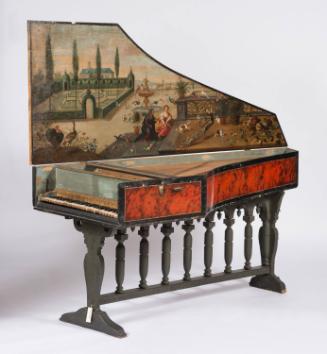
Photo credit: Don Kennedy
Joseph Johannes Couchet
1679
Not available for use in Recording Studios
On View: On exhibit
isVirtual:
Photo credit: Don Kennedy
Vido Trasuntino
1591
Available for use in Recording Studios
On View: Not currently on exhibit
isVirtual:
Photo credit: Don Kennedy
Kimball Piano and Organ Company
1924
Not available for use in Recording Studios
On View: On exhibit
isVirtual:
Photo credit: Don Kennedy
Mason & Hamlin Organ & Piano Company
1890
Not available for use in Recording Studios
On View: On exhibit
isVirtual:
Photo credit: Don Kennedy
The Story & Clark Piano & Organ Company
1941
Not available for use in Recording Studios
On View: Not currently on exhibit
isVirtual:
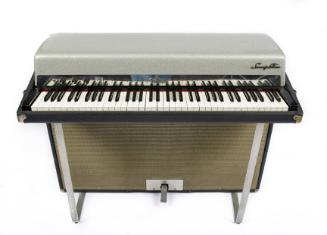
Photo credit: Don Kennedy
CBS Musical Instruments
1966
Available for use in Recording Studios
On View: Not currently on exhibit
isVirtual:
Photo credit: Don Kennedy
Electronic Music Studios (London) Limited
1969
Not available for use in Recording Studios
On View: Not currently on exhibit
isVirtual:
Photo credit: Meghan MacKrous, courtesy of the National Music Centre
CBS Musical Instruments
c. 1980
Available for use in Recording Studios
On View: Not currently on exhibit
isVirtual:
Photo credit: Don Kennedy
Pleyel et Cie
1913
Not available for use in Recording Studios
On View: Not currently on exhibit
isVirtual:
Photo credit: Don Kennedy
John Broadwood & Son
1899
Not available for use in Recording Studios
On View: On exhibit
isVirtual:
Photo credit: Don Kennedy
Oscar Schmidt Company
Unknown
Not available for use in Recording Studios
On View: Not currently on exhibit
isVirtual:
Back