EN / FR
Skip to main content

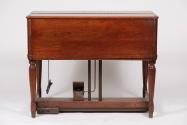
Hammond B-3

Not available for use in Recording Studios
Not currently on exhibit
Artifact TypeOrgan, Electromechanical
Manufacturer LocationUSA, North America
Date1957
After the piano, no other keyboard instrument has been used in more musical recordings than the Hammond B-3 organ. First designed in 1954 as a low-cost alternative to the acoustic church organ, the instrument enjoyed immense popularity in almost every genre of music, from jazz to funk to prog rock. Often paired with the Leslie 122 tone cabinet, the B-3’s distinctive and versatile sound can be heard on countless classic songs, including The Zombies’ “Time of the Season,” The Beatles’ “Let It Be” and Bob Dylan’s “Like a Rolling Stone.”
Operation/FunctionThis particular artifact contains a set of 91 tone wheel sound generators (fixed sine waveform), a pedal solo unit, and associated electromagnets and vacuum tubes for preamplification. Pitches are selected via an upper and lower manual, each with 61 notes (five-octave compass). An additional pedal section is located at the player’s feet, with 25 notes (two-octave compass) of low-frequency pitches. An extra octave (12 notes) of reverse-colored keys at the left of each manual serve as preset buttons, using a mechanical latch to hold their place once selected. The instrument’s tone is altered via five sets of swell drawbars: two sets of nine drawbars each for the upper manual, two sets of nine drawbars each for the lower manual, and one set of two drawbars for the pedals. The instrument is fully polyphonic and comes equipped with a switch for speed control (either fast/tremolo or slow/chorale) for the accompanying Leslie 122 amplifier and speaker cabinet, two power switches, switches for muting, and a volume pedal that can range up to 48 dB (decibels). Employs a 6-pin connector socket for the Leslie. The manuals span a frequency range of approximately 30 Hz to 6 kHz, and the pedals span a frequency range of approximately 16 Hz to 3 kHz.Cultural SignificanceThe cultural impact left by the Hammond B-3 simply cannot be overstated. Standing as among the most recorded keyboard instruments in history, succeeded only by the piano, the B-3 is a household instrument, so to speak, with an iconic tone that has remained familiar to the masses for decades. Indeed, it is nearly impossible to listen to the radio for even a short period of time without hearing the B-3 emerge at some point. There is, perhaps, no other keyboard instrument that has had such an influential range, helping to define the sound of a wide multitude of musical genres such as soul, funk, prog rock, blues, and jazz. The technical design of the Hammond organ was equally influential, with many early analog synthesizers employing a similar organ keyboard so as to appeal to the keyboardists of the time, who were largely dedicated to instruments such as the B-3. Despite its size, which weighs in at nearly 500 pounds, the B-3 propelled itself into the context of live performance and remains a standard instrument for many backline companies, along with instruments such as the Fender Rhodes electric piano and Hohner Clavinet; indeed, the fact that it has remained in such popular live use despite its size serves as a testament to the uniqueness of its tone. In addition to its use by professional musicians throughout the 1960s and 1970s, the Hammond organ also remained a successful commercial instrument, appealing to the consumer market alongside popular audio equipment of the day such as radios and stereos. Its unique and iconic sound remains fixed in the contemporary musical conscious, and it is widely regarded that, while the B-3 can emulate a number of other sounds, nothing else can sound quite like the B-3.Technological SignificanceAlthough the Hammond organ, and particularly the B-3, remains arguably the most commercially influential make of electromechanical organ, it was by no means the first. The first model A that emerged in 1935 was preceded by several early electromechanical organs employing a similar tone wheel mechanism and additive synthesis process. The first of these is usually considered to be Thaddeus Cahill’s Telharmonium, which emerged in 1897. The Telharmonium was a tremendously unwieldy instrument, consisting of enormous rotating electromagnetic alternators as tone generators at a time before even the vacuum tube had been invented and more streamlined amplification methods had been implemented. The instrument was highly unconventional in its design, fashioning cones out of several telephone receivers to act as a primitive loudspeaker, and employing telephone wires to broadcast its signals into the listener’s home. The first true commercial electromechanical organ came in 1928 with Frank Morse Robb’s wave organ. Robb, a Canadian inventor, employed a series of large metal discs, each with a particular waveform edged around its circumference, derived from recordings of an acoustic pipe organ projected onto an oscilloscope. These discs were organized onto twelve metal shafts and rotated by a motor when in use; the speed at which the discs rotated determined the octave in which they sounded. As with the B-3, Robb’s organ employed a series of electromagnets acting as pickups to amplify the signal. Perhaps the main difference between Robb’s design and Hammond’s, however, is that the tone wheels of the former were each edged to imitate specific timbres. As such, only preset sounds could be selected. Hammond’s tone wheels all produced simple sine tones, but the addition of an innovative and flexible drawbar system of layered overtones allowed the player of the Hammond organ to employ an additive synthesis process so as to construct their own timbres. Hammond also produced the Novachord in 1939, however this instrument produces its sound entirely by electronic means and is better classified as an early synthesizer than an electronic organ. The first Hammond organ was built with Laurens Hammond’s innovative synchronous motor and was designed as a modified version of Cahill’s Telharmonium. By employing an internal electromagnetic amplification system, the tone wheels of Hammond’s organ could be made to be immensely smaller than those of the Telharmonium. The most useful benefit of the synchronous motor, which rotates at the standard 60 Hz A/C cycle of North American mains, is that it holds a constant speed, preventing the instrument from drifting out of tune, which has remained a significant issue for many electronic instruments. The B-3 was perhaps the most successful among the electromechanical organs on account of the features it incorporated, which earlier units such as the model A, C, and B-2 lacked, such as the famed percussion and reverb/chorus scanner circuits. Hammond patented this reverb device, which was achieved via the helical torsion of a coiled spring; many subsequent manufacturers sought to emulate this design in their instruments. Since the instrument’s synchronous motor rotates every tone wheel simultaneously, a singular wheel’s pickup is occasionally susceptible to crosstalk, or bleed, from nearby wheels, picking up elements of their signal. This is not always viewed as a negative aspect by users, however, with many finding that it adds to the unique character of the instrument’s tone. As the instrument was initially meant to serve as a replacement for church organs, it parallels in several significant ways with traditional acoustic pipe organs. In most pipe organs, the various stops on the instrument are labeled so as to correspond with particular timbres; typically, when a stop is pulled, a selection of pipes from different sizes and ranks are isolated. As such, the independent characteristics of each rank are combined so as to produce an overall differing timbre. A similar process is employed in the Hammond organ, with drawbars selected to incorporate different overtone harmonics. This method is referred to as additive synthesis, and was a common technique employed in the earliest analog modular synthesizers of the late 1960s. The accompanying Leslie speaker cabinet, with its vibrato effect that can be varied in speed, served as a sort of primitive modulation effect. Although the B-3 can produce many organ-like and other sounds, it has a unique character all its own, informed in large part by the use of the Leslie, as it is usually called. Electronic instruments of the first half of the twentieth century were entirely vacuum tube-based, with solid-state devices such as the transistor representing the next generation in technology from the late 1950s and early 1960s onward. Solid-state technology was far smaller, lighter, more reliable, more durable, and less expensive than vacuum tube technology. This technology developed even further in around 1970 into the form of integrated circuits (ICs), which house the many discrete components of transistor-based circuits within a single silicon chip, as they are often called. Integrated circuits were significantly smaller and less expensive to manufacture than the circuits from which they derived. In the late 1960s, Hammond began manufacturing their first transistor-based organs, which employed only twelve tone wheels and a series of octave dividing circuits. By 1975, the instruments had ceased use of tone wheels altogether and were entirely comprised of integrated circuits. Tone wheels were not commonly used in other types of electronic organs, such as the combo organs of the 1960s, which generated their tones entirely by electronic means.Users/PerformersThere are literally countless examples of the B-3 in recorded and live music, spanning from the mid 1950s until the present, with usage permeating numerous genres, including rock, pop, soul, funk, jazz, blues, folk, reggae, and prog, in addition to various commercial uses. Among the most recognizable albums and compositions to feature the instrument include: Santana’s “Black Magic Woman/Gypsy Queen” from Abraxas of 1970 and “Evil Ways” from Santana of 1969; The Beatles’ “Let it Be” from Let It Be of 1970, performed by Billy Preston; Bob Dylan’s “Like a Rolling Stone” from Highway 61 Revisited of 1965; The Zombies’ “Time of the Season” from Odessey and Oracle of 1968; Steppenwolf’s “Born to be Wild” from Steppenwolf of 1968; Steve Miller Band’s “Fly Like an Eagle” from Fly Like an Eagle of 1976; Deep Purple’s “Hush” from Shades of Deep Purple of 1968, performed by Jon Lord; The Spencer Davis Group’s “Gimme Some Lovin’” from Autumn ‘66 of 1966; The Allman Brothers Band’s “Whipping Post” from The Allman Brothers Band of 1969; and, Chicago’s “A Hit by Varese” from Chicago V of 1972. Other notable tracks to have used very similar Hammond organ models, both console and spinet, include: Booker T and the MGs’ “Green Onions” from Green Onions of 1962, performed on a Hammond M-3; Yes’ “Close to the Edge” from Close to the Edge of 1972 and “Roundabout” from Fragile of 1971, both performed on a Hammond C-3 by Rick Wakeman; Janis Joplin’s “Me and Bobby McGee” from Pearl of 1970, performed by Ken Pearson; The Doors’ “Hyacinth House” from L.A. Woman of 1971, performed on a Hammond C-3 by Ray Manzarek; Deep Purple’s “Highway Star” from Machine Head of 1972, performed on a Hammond C-3 by Jon Lord; Procol Harum’s “Whiter Shade of Pale” and “Conquistador” from Procol Harum of 1967, performed on a Hammond M-102 by Matthew Fisher; Led Zeppelin’s “You Shook Me” from Led Zeppelin I of 1969, performed on an M-100 by John Paul Jones; and, Emerson, Lake & Palmer’s “Knife Edge” from Emerson, Lake & Palmer of 1970, performed on a Hammond C-3 by Keith Emerson. Electronically, most of these models are nearly identical, especially the C-3, which was essentially a B-3 housed within a more traditional organ-like console.
Object number2002.06.01.1-2
Photo credit: Don Kennedy
Vox Sound, Ltd.
c. 1967
Not available for use in Recording Studios
On View: Not currently on exhibit
isVirtual:
Photo credit: Don Kennedy
Elettronica Musicale Europea (EME) / Vox
c. 1968
Available for use in Recording Studios
On View: Not currently on exhibit
isVirtual:
Photo credit: Don Kennedy
Raymond Scott Enterprises/Manhattan Research
1957
Not available for use in Recording Studios
On View: Not currently on exhibit
isVirtual:
Photo credit: Don Kennedy
Optigan Corporation (of Mattel) / Opsonar (of Miner Industries)
c. 1973
Available for use in Recording Studios
On View: Not currently on exhibit
isVirtual:
Photo credit: Don Kennedy
Hohner Musikinstrumente GmbH & Co. KG
c. 1967
Available for use in Recording Studios
On View: Not currently on exhibit
isVirtual:
Photo credit: Don Kennedy
The Wurlitzer Company
c. 1970
Available for use in Recording Studios
On View: Not currently on exhibit
isVirtual:
Photo credit: Don Kennedy
Chamberlin Instruments Company, Inc.
1970
Not available for use in Recording Studios
On View: On exhibit
isVirtual:
Photo credit: Meghan MacKrous, courtesy of the National Music Centre
Kurzweil Music Systems
1985
Available for use in Recording Studios
On View: Not currently on exhibit
isVirtual:
Photo credit: Don Kennedy
Hammond Organ Company
1939
Available for use in Recording Studios
On View: Not currently on exhibit
isVirtual:
Photo credit: Don Kennedy
Hohner Musikinstrumente GmbH & Co. KG
c. 1950
Not available for use in Recording Studios
On View: Not currently on exhibit
isVirtual:
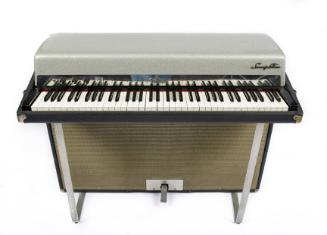
Photo credit: Don Kennedy
CBS Musical Instruments
1966
Available for use in Recording Studios
On View: Not currently on exhibit
isVirtual:
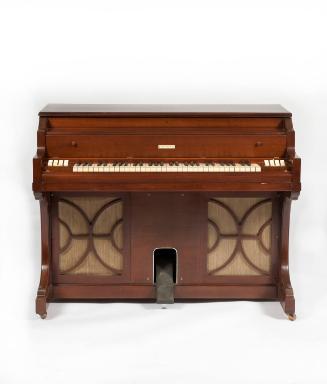
Photo credit: Don Kennedy
Everett Piano Company
1935
Not available for use in Recording Studios
On View: Not currently on exhibit
isVirtual:
Back