EN / FR
Skip to main content

Rolling Stones Mobile Recording Studio

Available for use in Recording Studios
On exhibit
On exhibit
Artifact TypeConsole, Recording
Manufacturer LocationTeddington, England, United Kingdom, Europe
Date1969

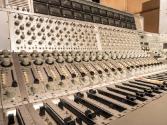
The Helios console inside the Rolling Stones Mobile Studio (RSM) was manufactured by Helios Electronics Ltd.in 1968. The company had been founded that same year by Dick Swettenham, former in-house technical director at Olympic Sound Studios who designed their popular custom recording desks. Helios specialized in making custom consoles for clients, including made-to-measure wrap-around layouts and steeply angled console sections that made controls more ergonomic for the engineers using them. The RSM was used as a mobile control room giving artists the flexibility to record wherever and whenever they wanted and cutting down on studio costs. The RSM’s Helios console recorded countless classic rock albums and live shows including those by Led Zeppelin, Deep Purple, Queen, Fleetwood Mac and of course, the Rolling Stones themselves. Former Stones bassist Bill Wyman bought the truck in the mid 80s and used it for the Ambition Invention Motivation Success (AIMS) project, providing free recording facilities to emerging artists throughout England. Acquired by National Music Centre in 2001, the RSM and its Helios console have been restored and are now parked next to the King Eddy stage, a historic live music venue, where they can record and live stream new music directly from the stage or connect to any of Studio Bell’s unique live rooms.

Operation/FunctionThis console is housed within a mobile studio that has been built into the interior of a large transport vehicle. The console itself features 24 input channels (32 channels including outputs) with associated equalization and volume controls, 24 mix groups, and 44 microphone lines. In addition to the console, this mobile studio also contains two 3M 24-track M79 2” tape recorders, an M79 two-track tape recorder, a 3M four-track tape recorder, a variable speed 7.5/15 i.p.s. Revox A77 tape recorder for producing slap back echo, Crown D60 and Yamaha amplifiers, a full rack-mounted TT patch bay, a pair of Klark-Teknik loudspeakers, modified with Dynaudio components, used for monitoring and mixing, and a pair of JBL 15” subwoofers. The truck onto which the studio is mounted was manufactured by BMC (British Motor Corporation); the aluminum trailer was originally left untreated but was modified with the AIMS Project logo in the late 1980s.Cultural SignificanceAlthough the presence of the Helios console dominated nearly every major sector of popular and rock music throughout the 1970s, with owners including The Beatles, Paul McCartney, Eric Clapton, Strawberry Studios, Olympic Studios, Richard Branson of Virgin Records, former Wrecking Crew pianist Leon Russell, The Who, and Hansa Tonstudio, perhaps the most iconic of these units ever produced is this particular artifact, which was manufactured specifically for use within the Rolling Stones Mobile Studio. In addition to engineering some of the most revered popular music of the twentieth century, including portions of Led Zeppelin’s IV of 1971, which features the massive hit “Stairway to Heaven”, the Rolling Stones Mobile Studio remained iconic in its highly innovative design, which employed a BMC (British Motor Corporation) truck as the exterior chassis. At the time, this design was groundbreaking, essentially remaining the only truly mobile option for professional recording throughout the 1970s.Technological SignificanceThe unique nature of the Rolling Stones Mobile Studio, which merged flexibility with technological sophistication, positioned it as a pioneering design throughout the 1970s. It eliminated the rigidity of working in a commercial recording studio, which typically demanded that sessions be completed during regular weekday business hours. More importantly, however, the way in which the mobile studio was confined to function primarily as the control room component of the studio allowed its users to become creative and innovative with their recording spaces. Many musicians not only found it liberating to work in alternative spaces such as concert halls, country estates, and even rural barns, but also aesthetically interesting, with unique acoustic properties emerging from within a particular building. Today, mobility is commonplace, with most handheld devices, such as smart phones, equipped with basic recording capabilities. Moreover, personal recording software, referred to as Digital Audio Workstations, or DAWs, offer extremely compacted alternatives to the larger consoles of the analog era while simultaneously featuring powerful signal effects processing. Of course, the technological legacy of Helios consoles in particular cannot be understated. Despite similar designs emerging from competing manufacturers such as SSL and Neve, Helios stood at the forefront of British console design, still revered to this day by the most famed musicians, engineers, and producers. Prior to the 1960s, most major studios oversaw the design and manufacture of their own consoles; as a result of the immense popularity of former Abbey Road engineer Dick Swettenham’s initial console, which was installed at Olympic Sound Studios in London, this model shifted dramatically, with notable studios and musicians commissioning customized units. Swettenham’s groundbreaking wrap-around design, which was developed in conjunction with Olympic Studios technician Keith Grant, allowed the recording engineer to remain in the center of the monitoring loudspeakers – an area that is referred to as the “sweet spot” – rather than having to shift back and forth across the length of the console. In terms of technical design, Helios consoles provided a constant sonic presence that was not overbearing but distinctive nonetheless. In particular, the equalization, or EQ, sections of the input channels were notable for their unique filtering shapes, with the earliest Type 69 modules revered for their musicality and the later Type 78 modules lauded for their versatility. Both were separated into three bands – treble, mid, and bass – and were capable of producing effective tonal coloration while still maintaining an illustrious clarity. These consoles benefitted from the use of Lustraphone transformers especially, which were particularly noticeable in the high-end microphone pre-amplifiers that were either integrated or accompanied in an external “lunch-box” format. The early multi-track era of recording, which gained traction throughout the 1960s and 1970s especially, was revolutionary in that it allowed for far greater clarity and fidelity within the realm of the final mix, as well as flexibility in terms of layering and overdubbing throughout the session itself.Users/PerformersThis console and its various components were used to capture numerous live and studio recordings throughout the 1970s and early 1980s, including some of the most iconic artifacts of rock and popular music history. Among the most notable albums to have been recorded either in full or in part within the studio are The Rolling Stones’ Sticky Fingers of 1971 and Exile on Main Street of 1972, Led Zeppelin’s III of 1970, IV of 1971, Houses of the Holy of 1973, and Physical Graffiti of 1975, Deep Purple’s Machine Head of 1972 and Burn of 1974, Frank Zappa’s 200 Motels film of 1971, which featured the studio onscreen painted in camouflage, Fleetwood Mac’s Mystery to Me and Penguin both of 1973, Uriah Heep’s Uriah Heep Live double album of 1973, Wishbone Ash’s Live Dates of 1973, Santana’s Moonflower of 1977, and Bob Marley and the Wailer’s Live! of 1975.
Object number2001.07.01
Photo credit: Don Kennedy
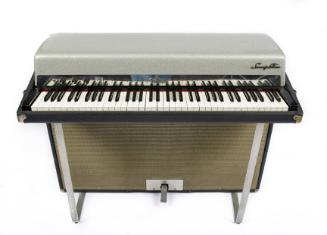
Hammond Organ Company
1957
Not available for use in Recording Studios
On View: Not currently on exhibit
isVirtual:
Photo credit: Don Kennedy
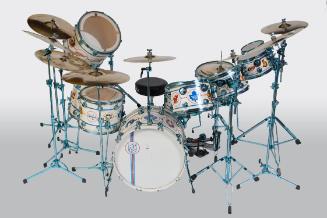
Drum Workshop, Inc.
2009
Not available for use in Recording Studios
On View: On exhibit
isVirtual:
Photo credit: Don Kennedy
Sequential Circuits Inc.
c. 1981
Available for use in Recording Studios
On View: Not currently on exhibit
isVirtual:
Photo credit: Don Kennedy
CBS Musical Instruments
1966
Available for use in Recording Studios
On View: Not currently on exhibit
isVirtual:
Photo Credit: Don Kennedy
Olympic Studios
1976
Available for use in Recording Studios
On View: Not currently on exhibit
isVirtual:
Photo credit: Don Kennedy
1974
Not available for use in Recording Studios
On View: On exhibit
isVirtual:
Photo credit: Meghan MacKrous, courtesy of the National Music Centre
Moog Music, Inc.
1976
Available for use in Recording Studios
On View: Not currently on exhibit
isVirtual:
Photo credit: Don Kennedy
Maurice Louis Eugène Martenot
1975
Available for use in Recording Studios
On View: Not currently on exhibit
isVirtual:
Photo credit: Don Kennedy
Electro Music / Donald Leslie
c.1972
Available for use in Recording Studios
On View: Not currently on exhibit
isVirtual:
Photo credit: Don Kennedy
Garnet "Gar" Gillies
c. 1960
Not available for use in Recording Studios
On View: On exhibit
isVirtual:
Photo credit: Don Kennedy
Garnet "Gar" Gillies
Available for use in Recording Studios
On View: Not currently on exhibit
isVirtual:
Photo credit: Don Kennedy
Kimball Piano and Organ Company
1924
Not available for use in Recording Studios
On View: On exhibit
isVirtual:
Back