EN / FR
Skip to main content

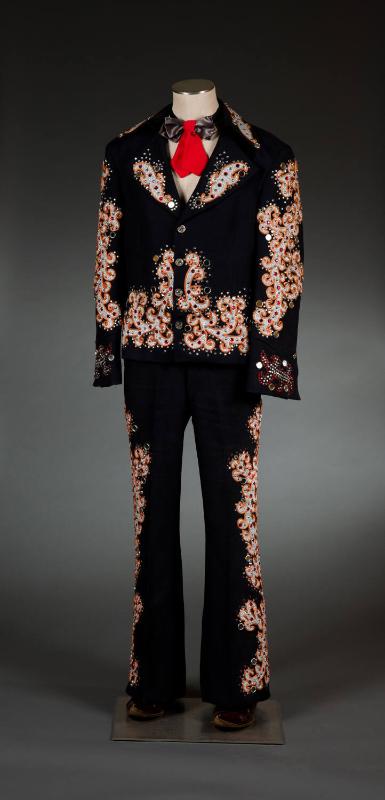
Hank Snow Stage Outfit

Not currently on exhibit
Artifact TypeEnsemble
Manufacturer Harvey Krantz
Manufacturer James Leddy
Manufacturer LocationUSA, North America
Date20th Century

This colourful custom suit, with matching bow tie and blood-red cowboy boots, was once owned by country music legend Hank Snow. Born in Nova Scotia, Snow broke through in Nashville—going on to sell an astonishing 70 million records worldwide. Though a traditionalist at heart, Snow’s hip-shakin’ take on classic country would inspire future rock ’n’ roll bad boys like Elvis Presley. In fact, Harvey Krantz, the California-based designer who made this outfit for Snow, also outfitted Elvis—as well as Liberace, James Brown and many others.

Suit made by Harvey Krantz (USA)

Boots made by James Leddy (USA)


Cultural SignificanceAlthough there are a number of musical styles that can be said to correspond with a particular fashion aesthetic, perhaps none is more iconic than that of the Country and Western genres. Throughout the 1950s, 1960s, 1970s, and 1980s, numerous stars of the country western scene, such as Roy Rogers and Gene Autry, looked to niche tailors to produce customized suits that would set them apart and establish a certain stage presence. The suits were often brightly coloured and elaborately adorned with tassels, sequins, imitation jewels and rhinestones, and intricate embroidery. They also typically consisted of a complete ensemble that included corresponding boots and hat. Arguably the most notable of such tailors was the Ukrainian immigrant Nuta Kotlyarenko (1902 – 1984) who became better known as Nudie Cohn of Hollywood, California. Nudie produced some of the most expensive custom garments, catering both to country superstars as well as high-profile performers in other popular genres, including Elton John, the Rolling Stones, and Elvis Presley. Other well-known tailors included Rodeo Ben, Turk of Van Nuys, California, Manuel of Nashville, Tennessee, and Rockmount Ranch Wear of Denver, Colorado.Users/PerformersHank Snow was born Clarence Eugene Snow on 9 May 1914 in Brooklyn, Queens County, Nova Scotia. Snow suffered a tumultuous childhood full of financial struggle, numerous relocations following the dissolution of his parents’ marriage, and child abuse at the hand of a stepfather and grandmother. His earliest musical experience came at age twelve in the form of a Hawaiian steel guitar his mother had purchased. In 1926, Snow ran away from home to escape continued domestic strife and joined the Merchant Marines, serving as a cabin boy and laborer on a fishing boat. Wages earned while posted on the boat allowed him to purchase his first guitar a few years later. In 1930, he returned home where he worked several odd jobs, once again purchasing a new guitar from an Eaton’s catalogue. Small, local performances began to garner popular interest among his hometown residents, and, in 1933, Snow auditioned to perform on Halifax’s CHNS radio station; after an initial rejection, he was eventually hired to lead an evening show. During this time, he adopted the proper name ‘Hank’ instead of ‘Clarence’ and became known as “Hank, the Yodeling Ranger,” in reference to one of his inspirations, yodeler Jimmie Rodgers. In 1936, Snow auditioned at the RCA Victor studio in Montréal, which led to the release of his first album on the subsidiary Bluebird label, a weekly radio show with the CBC in both Montréal and New Brunswick, and a series of Canadian tours. In 1945, Snow relocated to Nashville, Tennessee, taking on the new “Hank Snow, the Singing Ranger” moniker to recognize the change from his former high-range yodel to what would become his characteristic baritone range. In 1950 he was afforded his first opportunity to perform at the famed Grand Ole Opry, releasing his first number one hit, “I’m Moving On”, that same year; this song remained at the top of the charts for 21 consecutive weeks. While at the Grand Ole Opry, Snow was instrumental in persuading the theatre’s directors to allow a then-unknown Elvis Presley to perform as his opening act, effectively helping form his career. Despite slowing down in the 1960s, Snow continued to record and perform to large audiences until his contract with RCA was terminated in 1981. Snow was lauded for his songwriting and singing abilities; his songs dealt primarily with travel and being in transition, incorporating elements of Hawaiian music, Cowboy songs, and country boogie styles. Throughout his nearly 60 year career, Snow released an astounding 140 studio albums and has received numerous awards and accolades, including being inducted into the Nashville Songwriters Hall of Fame in 1978, the Country Music Hall of Fame in 1979, the Canadian Music Hall of Fame, the Nova Scotia Music Hall of Fame, and the Canadian Country Music Hall of Fame. Snow passed away on 20 December 1999 at his ranch in Madison, Tennessee. He remains one of the most iconic figures in country music, and Canada’s greatest contribution to the genre. In addition to his musical work, Snow was also a staunch supporter of organizations that help to combat child abuse. The Hank Snow Country Music Centre was established in Liverpool, Nova Scotia near Hank’s hometown.
Object numberT.2016.35.1-3
Photo credit: Don Kennedy
Harvey Krantz
20th Century
On View:
isVirtual:
Photo credit: Don Kennedy
LaFleche Brothers
c. 1970
On View: Not currently on exhibit
isVirtual:
Photo credit: Don Kennedy
Harvey Krantz
20th Century
On View: Not currently on exhibit
isVirtual:
Photo credit: Don Kennedy
Manuel Cuevas
20th Century
On View:
isVirtual:
Photo credit: Don Kennedy
Harvey Krantz
20th Century
On View: Not currently on exhibit
isVirtual:
Photo credit: Don Kennedy
20th Century
On View: Not currently on exhibit
isVirtual:
Photo credit: Don Kennedy
Manuel Cuevas
1998
On View: Not currently on exhibit
isVirtual:
Photo credit: Don Kennedy
Moog Music, Inc.
1973
Available for use in Recording Studios
On View: Not currently on exhibit
isVirtual:
Photo credit: Meghan MacKrous, courtesy of the National Music Centre
R.A. Moog, Inc.
1970
Available for use in Recording Studios
On View: Not currently on exhibit
isVirtual:
Photo credit: Don Kennedy
Gerri Schneider
20th Century
On View:
isVirtual:
Photo credit: Don Kennedy
Chamberlin Instruments Company, Inc.
1979
Available for use in Recording Studios
On View: Not currently on exhibit
isVirtual:
Photo credit: Don Kennedy
On View: Not currently on exhibit
isVirtual:
Back