EN / FR
Skip to main content

Hurdy-Gurdy

Not available for use in Recording Studios
Not currently on exhibit
Artifact TypeHurdy-Gurdy
Manufacturer LocationHungary
Date1999
The hurdy-gurdy is among the oldest, most innovative, and unique musical instruments, and stands as the first stringed instrument to successfully incorporate a keyboard mechanism.  In effect, it merges the design approaches of the violin, with its rotating “bowed” wheel, and the bagpipes, in its use of both a droning texture and a melodic texture.  It is an iconic instrument in many folk music traditions, especially those of eastern Europe.

Though composed of traditional materials – a wood body with gut strings - this hurdy gurdy is a modern example of an instrument with a long history. The hurdy-gurdy is among the oldest, most innovative, and unique musical instruments, and stands as the first stringed instrument to successfully incorporate a keyboard mechanism. It also merges the design approaches of the violin, with its rotating "bowed" wheel, with the bagpipes, in its use of both a droning texture and a melodic texture. It is an iconic instrument in many folk music traditions, especially those of eastern Europe, however, since its origins in the medieval period it has been used in a variety of musical genres: throughout the Baroque and Classical eras popular composers such as Antonio Vivaldi and Wolfgang Amadeus Mozart wrote for the instrument, and today it can be found in popular music, European folk music – including Hungarian, Catalan, Sardinian, and Cajun French music - classical music, and even experimental and electronic music.

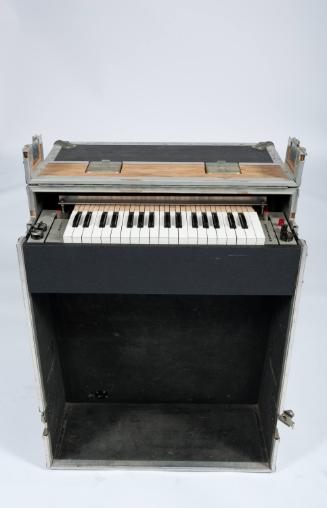
Operation/FunctionThis particular artifact consists in a wooden body, soundboard, and rotating wheel as well as a set of gut strings and twenty-three keys, arranged in a two-octave chromatic setting.Cultural SignificanceAlthough the hurdy-gurdy has been used in a number of different musical styles to represent both the peasantry and the nobility throughout its nearly nine centuries of existence, its everlasting effect remains most prominent in regard to French culture of pre-Napoleonic times, and, especially, eastern European folk music. The latter stands as the genre in which the instrument is still most frequently used. Its unique design and highly idiomatic sound have rendered it something of a niche and curious historical relic. Despite its decidedly religious origins, its combination of a fixed texture with a melodic texture made it quite apt for dance music of the Renaissance.Technological SignificancePerhaps as a byproduct of being among the oldest musical instruments that is still in popular use, the hurdy-gurdy stands today as one of the most unique and innovative stringed instruments. Centuries prior to the advent of instruments such as the clavichord and harpsichord, the hurdy-gurdy was essentially the first stringed instrument to incorporate a keyboard-like mechanism for pitch control. Its origins are believed to date to the twelfth century in southern and western Europe, where it was likely to have developed from instruments such as the viol or fiddle. Some accounts suggest that it may have even derived from the rebab, a bowed string instrument native to many parts of the Middle East and North Africa, possibly brought to Spain by the Moorish invaders. The first predecessor to the hurdy-gurdy is often considered to be the organistrum, which employed a similar wheel mechanism that, when rotated, bowed across both drone strings and melodic strings. This instrument was large and fairly tedious to operate, which resulted in its use being restricted to the performance of the slower, more simplistic choral works of monastic European churches. The solo organistrum derived from this as a more compact version suitable for one person to perform alone. The symphonia emerged shortly after with improvements to the keyboard mechanism, allowing for the performance of more varied repertoire. The combination of a bowed approach with the complex texture of instruments such as the bagpipes, as exhibited in the hurdy-gurdy, was highly innovative for the time, and remains largely unparalleled even today. Perhaps the most unique aspect of the hurdy-gurdy is its implementation of the buzzing bridge, which first appeared in the instrument during the Renaissance. Since the eighteenth century, when the popular vielle à roue style emerged from France, there have, generally speaking, been two forms of the instrument. Small-wheel hurdy-gurdies typically feature only three strings, and include the German and Austrian Drehleier, the Hungarian tekerolant, and the Polish and Ukrainian lira. Large-wheel hurdy-gurdies can incorporate between five and fifteen strings, and include the vielle à roue and the Spanish Zanfona. Both small- and large-wheel hurdy-gurdies may or may not incorporate a buzzing bridge; neither the lira nor the Zanfona feature such a mechanism. Similar instruments to have developed from the hurdy-gurdy include the dulcigurdy, which employs the player’s fingers instead of keys to fret the melodic strings, the nyckelharpa, which is a Swedish hurdy-gurdy that employs an actual bow, and the viola organista, which was designed by Leonardo da Vinci as a significantly larger version of the instrument.Users/PerformersThe hurdy-gurdy has been used in a variety of musical styles since its origins in the medieval period. Throughout the Baroque and Classical eras, popular composers of the era such as Antonio Vivaldi and Wolfgang Amadeus Mozart wrote for the instrument. Today, it can be found in popular music, European folk music including Hungarian, Catalan, Sardinian, and Cajun French music, Classical music, and even experimental and electronic music.
Object number2007.05.01
Photo credit: Don Kennedy
c. 1800
Not available for use in Recording Studios
On View: Not currently on exhibit
isVirtual:
Photo credit: Don Kennedy
Sébastien Érard
1820
Not available for use in Recording Studios
On View: On exhibit
isVirtual:
Bösendorfer Klavierfabrik GmbH
1855
Not available for use in Recording Studios
On View: Not currently on exhibit
isVirtual:
Photo credit: Don Kennedy
Venczel József Schunda
c. 1905
Not available for use in Recording Studios
On View: Not currently on exhibit
isVirtual:
Photo credit: Don Kennedy
Carl (Karl) Leopold Röllig
c. 1800
Not available for use in Recording Studios
On View: Not currently on exhibit
isVirtual:
Photo credit: Don Kennedy
Kimball Piano and Organ Company
1924
Not available for use in Recording Studios
On View: On exhibit
isVirtual:
Photo credit: Don Kennedy
Streetly Electronics/ Mellotronics/ Mellotron
1971
Not available for use in Recording Studios
On View: On exhibit
isVirtual:
Photo credit: Don Kennedy
Mellotron (Mellotronics Manufacturing)
1973
Not available for use in Recording Studios
On View: Not currently on exhibit
isVirtual:
Photo credit: Don Kennedy
Novatron
c. 1981
Available for use in Recording Studios
On View: Not currently on exhibit
isVirtual:
Photo credit: Don Kennedy
Johannes Zumpe
1766
Not available for use in Recording Studios
On View: On exhibit
isVirtual:
Photo credit: Don Kennedy
Symphonion Company
c. 1890
Not available for use in Recording Studios
On View: On exhibit
isVirtual:
Photo credit: Don Kennedy
Electro Music / Donald Leslie
c.1972
Available for use in Recording Studios
On View: Not currently on exhibit
isVirtual:
Back